Compute is no longer measured purely in CPU cycles or RAM. Explore how the shift to token-based economics alters enterprise software architecture.
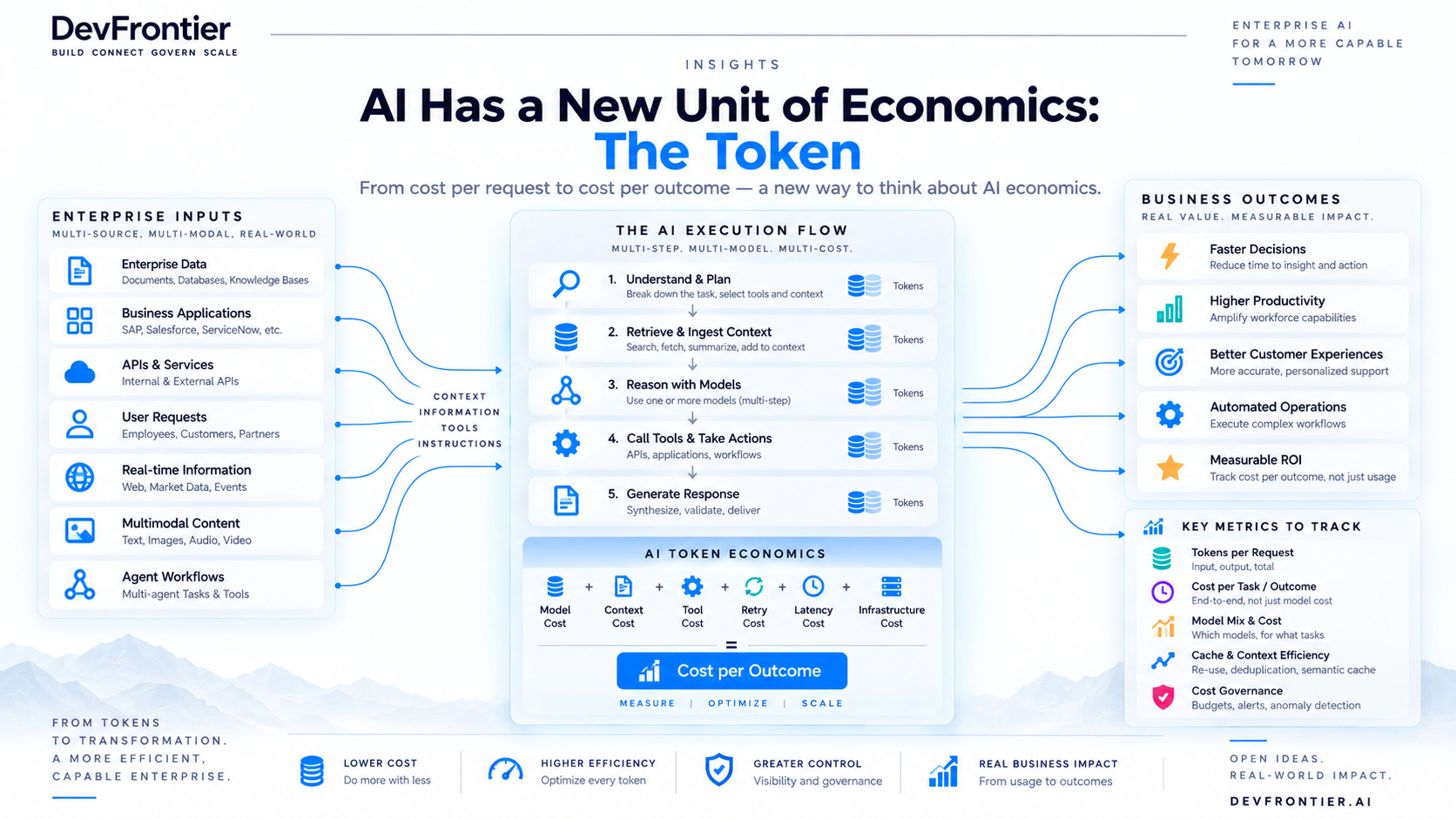
AI Cost: AI Has a New Unit of Economics: The Token
For the last two decades, enterprise software engineering has been optimized around a few fundamental units of cost: CPU cycles, memory (RAM), storage space (GBs), and network bandwidth. Cloud providers built trillion-dollar empires renting out these primitives, and FinOps teams built sophisticated methodologies to optimize their consumption.
But the advent of Large Language Models (LLMs) has introduced a radical new unit of economics to the enterprise: The Token.
A token is roughly equivalent to 3/4 of a word. But more importantly, a token is a unit of cognitive computation. Unlike CPU cycles, which scale linearly with load, tokens scale geometrically with task complexity, context length, and agentic reasoning loops.
If your engineering teams are still optimizing for cloud compute but ignoring token compute, your enterprise is about to experience a massive, unpredictable surge in infrastructure costs.
The Hidden Costs of Agentic Workflows
In a standard web application, a user clicks a button, a database query runs, and JSON is returned. The cost of that transaction is a fraction of a cent.
In an Agentic AI application, a user makes a request. The agent then:
- Reads the system prompt (1,000 tokens).
- Reads the conversation history (3,000 tokens).
- Reasons about what tools to use (500 tokens).
- Executes a database query and ingests the raw results (8,000 tokens).
- Realizes the results are incomplete, and reasons again (1,000 tokens).
- Executes a second query (4,000 tokens).
- Synthesizes a final response (1,000 tokens).
This is the hidden danger of Agentic AI. The autonomous nature of reasoning loops means that token consumption is non-deterministic. An agent might solve a problem in 1 step, or it might hallucinate, retry, and burn through 20 steps before hitting a hard limit.
Strategies for Token Optimization (AI FinOps)
To survive the shift to token economics, enterprises must adopt new architectural paradigms designed specifically for AI Cost Optimization (often called AI FinOps).
1. Semantic Caching
Traditional caching (like Redis) relies on exact string matching. If a user asks, "What was our Q3 revenue?" and another asks, "How much revenue did we make in Q3?", a traditional cache sees two different strings and sends both to the expensive LLM.
Semantic Caching embeds the incoming query into a vector space. If a new query is semantically identical (e.g., >95% cosine similarity) to a previously answered query, the system bypasses the LLM entirely and returns the cached response.
This single optimization can reduce token consumption for repetitive enterprise queries (like HR FAQs or standard reporting) by up to 60%.
2. Intelligent Model Routing
Not every task requires a massive, 1-trillion-parameter frontier model.
- Generating a complex, multi-step Python script requires a frontier model (expensive).
- Extracting a name and date from an email requires a small, specialized model (cheap).
Enterprises must implement Intelligent Routers. These are fast, ultra-cheap classification models that analyze an incoming prompt and dynamically route it to the most cost-effective LLM capable of handling the task. By offloading 80% of mundane tasks to cheaper models, enterprises can drastically reduce their blended token cost.
3. Context Window Truncation and Summarization
Agents are often fed massive amounts of context "just in case" they need it. Injecting a 50-page PDF into every prompt because a user might ask a question about it is a recipe for bankruptcy.
Instead, enterprises should use dynamic RAG (Retrieval-Augmented Generation) to only inject the specific paragraphs relevant to the immediate step in the reasoning loop. Furthermore, long conversation histories should be periodically summarized by a cheap, fast model to compress the token count before feeding the history back into the expensive reasoning model.
The Role of the AI Cost Monitor
You cannot optimize what you cannot measure. The first step in mastering token economics is implementing robust observability.
At DevFrontier, we developed the AI Cost Monitor specifically for this purpose. It sits at the integration layer, tracking every single token generated across every model provider (OpenAI, Anthropic, Google, local open-source models). It attributes these costs back to specific teams, applications, and even individual agent reasoning loops.
By providing real-time visibility into token burn rates, identifying inefficient prompts, and highlighting tasks ripe for model downgrading, the AI Cost Monitor allows enterprises to scale their AI ambitions without scaling their budgets out of control.
Token economics are here to stay. Master them, and your AI initiatives will be highly profitable. Ignore them, and they will become an insurmountable liability.