RAG is not enough. To truly scale Agentic AI, enterprises must move to real-time Context Compute architectures.
Enterprise Context Compute for Agentic AI
Retrieval-Augmented Generation (RAG) was the defining AI architecture of 2024. It solved a massive problem: Large Language Models (LLMs) didn't know your proprietary enterprise data. By chunking PDFs, embedding them into a vector database, and doing a similarity search before generating a response, enterprises finally got chatbots that could quote their own internal HR manuals.
But as the industry pivots from chatbots to autonomous Agentic AI, the limitations of standard RAG have become glaringly obvious.
RAG is inherently static and document-centric. If you want to build an AI agent that can negotiate a vendor contract based on live inventory levels, current market pricing, and dynamic supplier API statuses, a vector database full of PDFs won't help you.
Agentic AI doesn't just need retrieved documents; it needs Context Compute.
What is Context Compute?
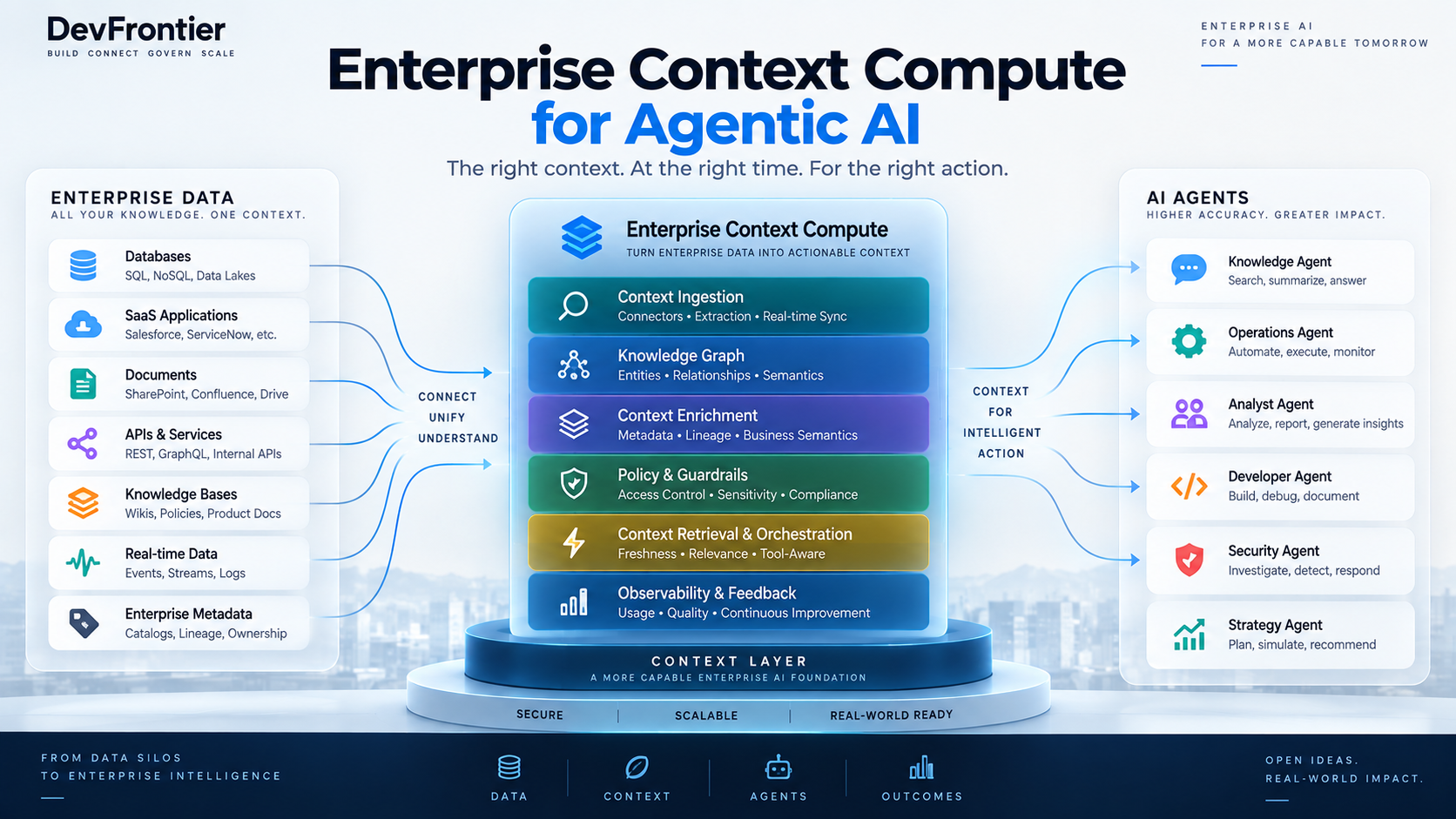
Context Compute is the architectural layer that sits between your foundational enterprise systems (CRMs, ERPs, event streams) and your AI agents. Its purpose is to aggregate, transform, and compute real-time state into a unified context payload at inference time.
<Callout type="info" title="The Context Difference"> **Standard RAG:** "Find the top 5 paragraphs from our wiki that contain words similar to 'inventory'."<br/> **Context Compute:** "Run a live GraphQL query against the warehouse API, calculate the burn rate of inventory over the last 48 hours, and inject that computed state into the agent's prompt." </Callout>The Three Pillars of Context Compute
To build a robust Context Compute pipeline, data engineering teams must move beyond simple vectorization scripts and embrace a multi-modal data architecture.
1. Live State Integration (The "Right Now")
Agents need to know what is happening at this exact millisecond. This requires real-time API integrations and event stream consumption (e.g., Kafka). When an agent is invoked to assist a customer, the Context Compute layer must instantly fetch the customer's live cart contents, their last interaction timestamp, and current server status.
2. Relational Aggregation (The "Structured Truth")
Not all data belongs in a vector database. Relational data (SQL databases, Snowflake, Databricks) holds the structured truth of an enterprise. Context Compute layers must be capable of executing parameterized SQL queries to pull aggregated financial metrics, user cohorts, or inventory counts, transforming them into structured JSON or Markdown tables that an LLM can easily reason over.
3. Semantic Retrieval (The "Knowledge Base")
Semantic search (traditional RAG) still plays a role, but it is demoted to being just one of many context streams. The Context Compute layer decides when to query the vector database, using semantic routing to only inject unstructured knowledge when the agent's task explicitly requires historical context or unstructured documentation.
The Architectural Shift
Building a Context Compute layer requires a fundamental shift in how we think about AI application architecture.
<Figure src="/darklogo.png" alt="Context Compute Architecture" caption="An illustration of a Context Compute pipeline combining live APIs, SQL data, and vector search before hitting the LLM." />Abandoning the "Mega-Prompt"
Historically, developers tried to stuff as much context into the initial system prompt as possible. This "mega-prompt" approach leads to massive token costs, increased latency, and a phenomenon known as "Lost in the Middle," where LLMs forget instructions hidden deep within massive text blocks.
Context Compute relies on Just-In-Time (JIT) Context. As an agent reasons through a problem using a ReAct (Reasoning and Acting) loop, it dynamically requests specific context from the compute layer via tool calls. The compute layer fetches, formats, and returns exactly what is needed for that specific reasoning step, and nothing more.
DevFrontier's AI Data Engineer
Building a Context Compute layer from scratch is incredibly difficult. It requires writing hundreds of custom API connectors, managing stateful data pipelines, and dealing with massive data transformations just to get a clean JSON payload to an LLM.
This is why DevFrontier built the AI Data Engineer. This product acts as a smart middleware that sits on top of your existing data infrastructure. It uses AI to automatically generate data pipelines, map enterprise schemas to natural language, and expose a clean, unified Context API that your autonomous agents can query in real-time.
By abstracting away the complexity of real-time data aggregation, the AI Data Engineer allows your enterprise to focus on what actually matters: building agents that act on real-time truth, rather than stale documents.