Relying on a single AI provider is a strategic liability. Learn how to architect a model-agnostic infrastructure for maximum agility.
Enterprise AI Will Be Multi-Model — So Model Choice Becomes an Infrastructure Problem
In the early days of enterprise cloud migration, a fierce debate raged: should an enterprise go "all-in" on a single cloud provider (AWS, GCP, or Azure), or should they adopt a multi-cloud strategy to avoid vendor lock-in?
Today, a nearly identical debate is happening in the boardroom regarding Artificial Intelligence. Should an enterprise standard on OpenAI, Anthropic, Google, or an open-source ecosystem like Meta's LLaMA?
The answer is rapidly becoming clear: Enterprise AI will be inherently multi-model.
No single foundation model will dominate every benchmark, every modality, and every cost tier forever. Model capabilities leapfrog each other on a monthly basis. If you hardcode your enterprise applications to a single provider's API, you are tying your strategic agility to their release schedule.
The Risks of Single-Model Lock-in
Tying your entire AI infrastructure to a single provider introduces several critical strategic liabilities:
- The Cost Trap: Different tasks require different levels of intelligence. Using a frontier model to perform simple data extraction is like using a supercomputer to run a calculator. If you are locked into a single provider, you often lack the granularity to route simple tasks to ultra-cheap models.
- Downtime and Rate Limits: Outages happen. If your customer service AI agent relies entirely on one provider, an API outage takes your entire customer support function offline.
- The Leapfrog Effect: If a competitor releases a model that is 50% cheaper and 20% faster, but your application logic is tightly coupled to your current provider's proprietary SDK and prompt formatting, the migration cost will prevent you from taking advantage of the innovation.
Architecting for Model Agility
To survive and thrive in a multi-model ecosystem, the choice of which model to use must be decoupled from the application logic.
Model choice is no longer an application development problem; it is an infrastructure problem.
The Universal API Gateway
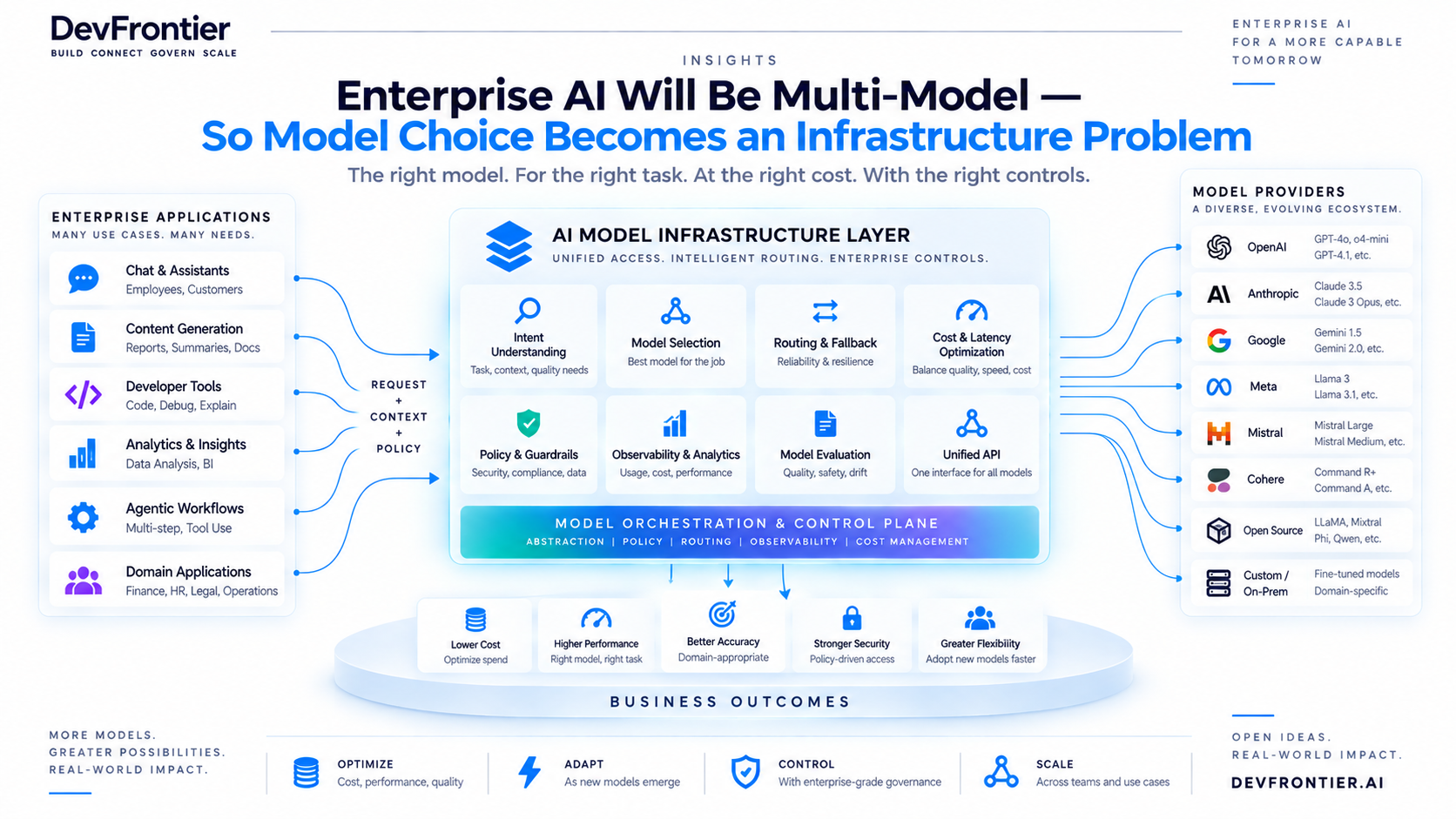
The foundation of a multi-model strategy is a Universal AI Gateway. Instead of your applications calling the OpenAI or Anthropic APIs directly, they call a centralized internal gateway.
<Callout type="warning" title="The Danger of SDK Lock-in"> Do not allow your development teams to directly import proprietary AI SDKs into their microservices. Mandate the use of a unified, provider-agnostic interface (often mimicking a standard OpenAI-compatible REST schema) hosted by your internal gateway. </Callout>This gateway abstracts away the complexities of different provider SDKs, handling retries, authentications, and payload formatting behind the scenes.
Semantic Routing
Once all traffic flows through a central gateway, you can implement Semantic Routing.
When a prompt hits the gateway, a small, lightning-fast classifier model evaluates the request.
- Is it a simple summarization task? Route it to a fast, cheap open-source model like LLaMA-3 8B.
- Is it a highly complex coding task requiring deep reasoning? Route it to a frontier model.
- Is the primary provider experiencing high latency? Instantly failover to the secondary provider's equivalent model.
Semantic routing guarantees that you are always paying the absolute minimum required token cost for the desired level of intelligence.
Standardizing Prompts Across Models
The final hurdle in a multi-model strategy is prompt compatibility. A prompt that works brilliantly on one model might yield terrible results on another due to differing training methodologies and system prompt sensitivities.
Enterprises must invest in Prompt Registries—centralized repositories where prompts are versioned, tested, and optimized for specific models. When the gateway routes a request, it fetches the specific prompt variant optimized for the destination model.
DevFrontier's AI Integration Suites
Architecting a resilient, model-agnostic gateway with semantic routing and prompt management is a massive engineering undertaking.
At DevFrontier, our AI Integration Suites provide this exact infrastructure out of the box. We give enterprises a single, unified interface to connect with Databricks, Snowflake, Salesforce, and any foundation model—proprietary or open-source.
By treating model choice as an infrastructure configuration rather than hardcoded application logic, DevFrontier allows you to seamlessly swap models as the landscape evolves, ensuring you always have access to the frontier of AI capabilities without the switching costs.