Why brittle point-to-point API connections are holding back enterprise AI, and how a dedicated Integration Layer solves the chaos.
The Enterprise AI Stack Is Missing an Integration Layer
Look at any enterprise architecture diagram for an AI application built in the last two years, and you will see a familiar, chaotic web.
The Large Language Model sits in the center. Emanating from it are dozens of thin, fragile lines representing point-to-point API integrations. One line goes to Salesforce to fetch a CRM record. Another goes to Snowflake to run a query. Another hits an internal Slack webhook.
This architecture works perfectly well for a weekend hackathon or a Proof of Concept (POC). But when you attempt to deploy this to production, the entire system collapses under its own weight.
The missing component in the modern Enterprise AI stack isn't a better vector database or a faster foundational model. It is a dedicated Integration Layer.
The Point-to-Point Nightmare
Why do point-to-point AI integrations fail in production?
<Callout type="warning" title="The Brittle Agent"> When an AI agent relies on direct API calls encoded into its system prompt, a single undocumented API change from a vendor will cause the agent to hallucinate, fail silently, or worse, execute a malformed request that corrupts data. </Callout>- Authentication Sprawl: Every system requires different authentication (OAuth, Bearer Tokens, Mutual TLS). Forcing the AI reasoning loop or the thin application wrapper to manage token refreshes across 20 different enterprise systems is a security disaster waiting to happen.
- Schema Hallucinations: When an LLM is given raw OpenAPI specs and told to "figure it out," it will inevitably hallucinate parameters or fail to understand the nuanced business logic of your specific ERP deployment.
- Lack of Observability: If an agent fails to execute a task, where did it fail? Did the LLM reason incorrectly? Did the target API time out? Did the database reject the payload? Without a central integration layer, tracing the root cause of an agentic failure is nearly impossible.
The Role of the AI Integration Layer
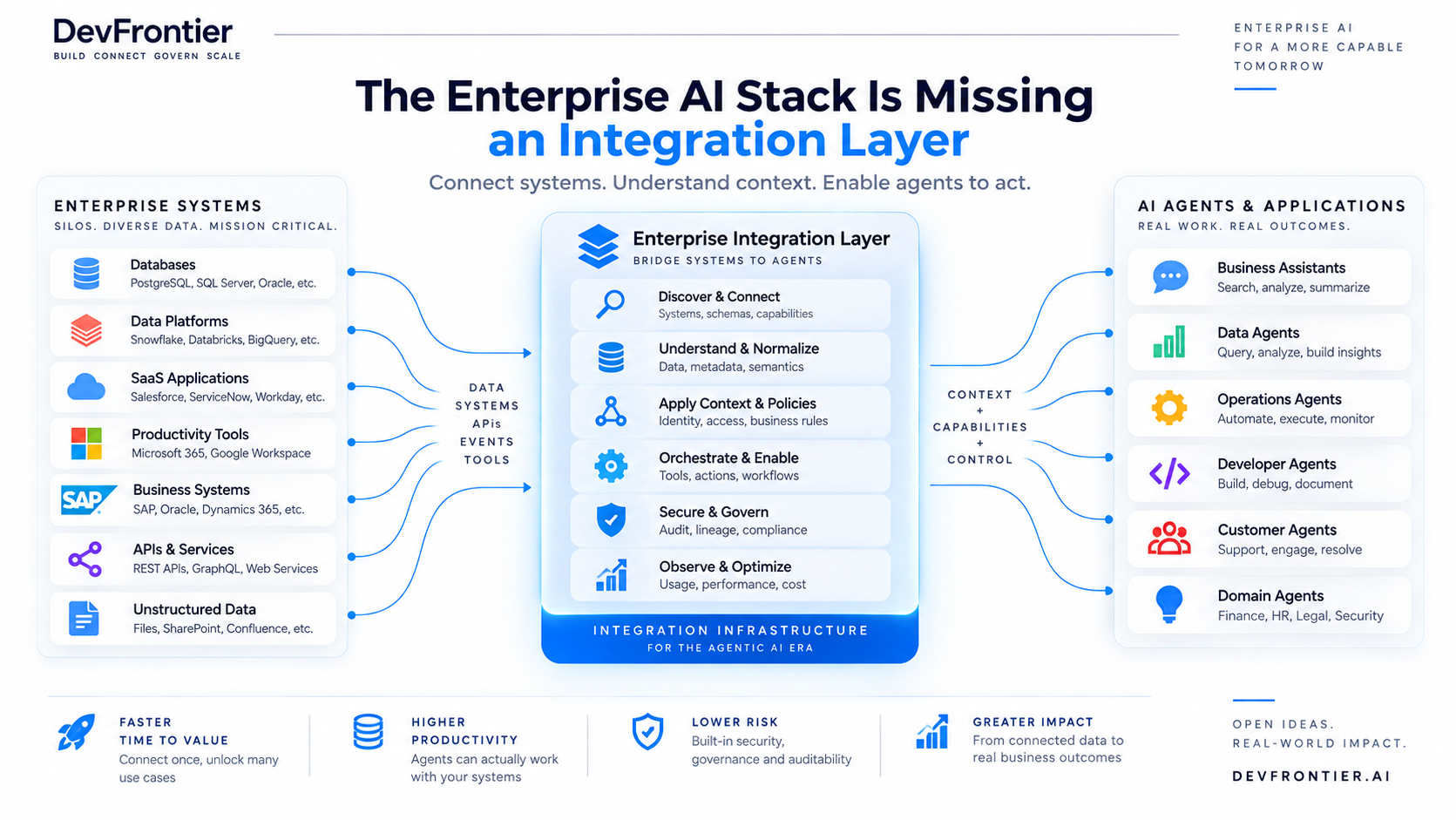
An AI Integration Layer acts as the central nervous system for your autonomous agents. It sits between your AI models and your enterprise data systems, standardizing, securing, and monitoring all communication.
<Figure src="/darklogo.png" alt="Integration Layer Diagram" caption="The AI Integration Layer abstracts away the complexity of enterprise systems, presenting clean, semantic tools to the LLM." />1. Semantic Tool Abstraction
Instead of handing an LLM a raw, 5,000-line Swagger file for your ERP, the Integration Layer translates complex API endpoints into simple, semantic "Tools".
For example, the Integration Layer exposes a tool called get_customer_health_score(customer_id). When the LLM calls this tool, the Integration Layer handles the heavy lifting: it fetches the support tickets from Jira, the ARR from Salesforce, and the usage metrics from Databricks, calculates the score using a deterministic script, and returns a single, clean integer to the LLM.
The LLM never has to know how Jira or Salesforce works.
2. Centralized Authentication & Security
The Integration Layer holds the keys to the kingdom. It integrates directly with your enterprise Identity Provider (IdP) and manages all OAuth handshakes and API keys.
When an agent wants to act, the Integration Layer verifies the agent's identity, checks its Role-Based Access Control (RBAC) policies, and executes the downstream API call securely. This ensures that the AI model itself never has access to raw credentials, massively reducing the blast radius of a potential breach.
3. Resiliency and Fallbacks
APIs go down. Rate limits get hit. In a point-to-point architecture, an API timeout causes the agent to crash or hallucinate an apology to the user.
The Integration Layer provides standard middleware features: exponential backoffs, circuit breakers, and automatic retries. If the primary database is locked, the Integration Layer can silently route the agent's query to a read-replica without the LLM ever knowing there was a hiccup.
DevFrontier: Building the Connective Tissue
The transition from AI as a "cool toy" to AI as a "core business driver" requires enterprise-grade infrastructure.
At DevFrontier, we recognized that the integration layer was the single biggest bottleneck preventing enterprises from moving their AI agents into production. That is why our core product offering centers around AI Integration Suites.
We provide pre-built, semantic connectors for the world's most complex enterprise systems—Databricks, Snowflake, Salesforce, Zoho, PostgreSQL, and more. Our suites handle the authentication, the schema mapping, and the resiliency, allowing your AI agents to do what they do best: reason and act.
Stop writing bespoke Python scripts to connect your LLMs to your databases. Implement an Integration Layer, and let your AI scale.