Why prompt engineering and model-level guardrails are insufficient for Agentic AI, and why operational governance must take center stage.
Governance: When AI Can Act, Governance Has to Move Beyond the Model
The era of the "chat-only" AI is drawing to a close. Over the past three years, enterprise adoption of Large Language Models (LLMs) was primarily characterized by conversational interfaces—assistants that could draft emails, summarize documents, and generate code. In this paradigm, AI was a sophisticated oracle. You asked a question; it gave an answer.
But a profound architectural shift is currently underway. We are rapidly transitioning from Generative AI to Agentic AI.
Agentic AI systems don't just generate text—they act. Armed with tool use, reasoning capabilities, and access to enterprise APIs, these autonomous agents can execute database queries, orchestrate cloud infrastructure, send customer communications, and modify financial records.
When AI crosses the chasm from generating information to executing actions, the rules of governance fundamentally change.
The Limitation of Model-Level Guardrails
To date, the AI industry has overwhelmingly focused on model-level safety. We have spent countless research hours perfecting RLHF (Reinforcement Learning from Human Feedback), red-teaming foundation models against prompt injections, and deploying sophisticated system prompts to ensure models refuse harmful requests.
<Callout type="warning" title="The False Sense of Security"> Relying purely on model-level guardrails for an autonomous agent is equivalent to relying on a database user's promise to "behave nicely" instead of implementing Row-Level Security and IAM roles. </Callout>Model-level guardrails are statistical, not deterministic. An LLM is a probabilistic engine; no matter how robustly it is fine-tuned, there is always a non-zero chance of a hallucination, a successful jailbreak, or a logical reasoning failure.
When an AI is just generating text, a hallucination is embarrassing. When an AI has write-access to your production Snowflake environment or your Salesforce CRM, a hallucination is a catastrophic security incident.
The Attack Vectors of Agentic AI
Consider an enterprise AI agent designed to help the sales team update lead statuses. The agent has been given a tool: update_lead_status(lead_id, status).
If an attacker manages to inject a malicious prompt into an incoming email that the agent reads (an Indirect Prompt Injection), the model might be tricked into executing update_lead_status on every lead in the database, setting them all to "Closed Lost."
Model-level governance attempts to solve this by training the model to recognize indirect prompt injections. But this is a never-ending arms race. As attackers discover new adversarial techniques, the statistical guardrails will inevitably fail.
Operational Governance: The New Standard
To secure Agentic AI, enterprises must shift their focus from the model to the environment in which the model operates. We call this Operational Governance.
Operational Governance accepts that the LLM is an untrusted, probabilistic actor. Instead of trying to make the model mathematically perfect, we build deterministic, unbreachable systems around the model's actions.
1. Identity and Access Management (IAM) for Agents
Agents must be treated as non-human identities within the enterprise identity provider (IdP). An agent should never use a god-mode API key.
- Principle of Least Privilege: An agent designed to read analytics should only have
READaccess to specific, non-PII tables. - Ephemeral Credentials: Agents should request short-lived, just-in-time credentials for specific tasks, rather than relying on hardcoded long-lived tokens.
- Contextual Execution: If an employee asks an agent to fetch a report, the agent should execute that query using the employee's permissions (On-Behalf-Of flow), not a generic service account.
2. The Tool Execution Gateway
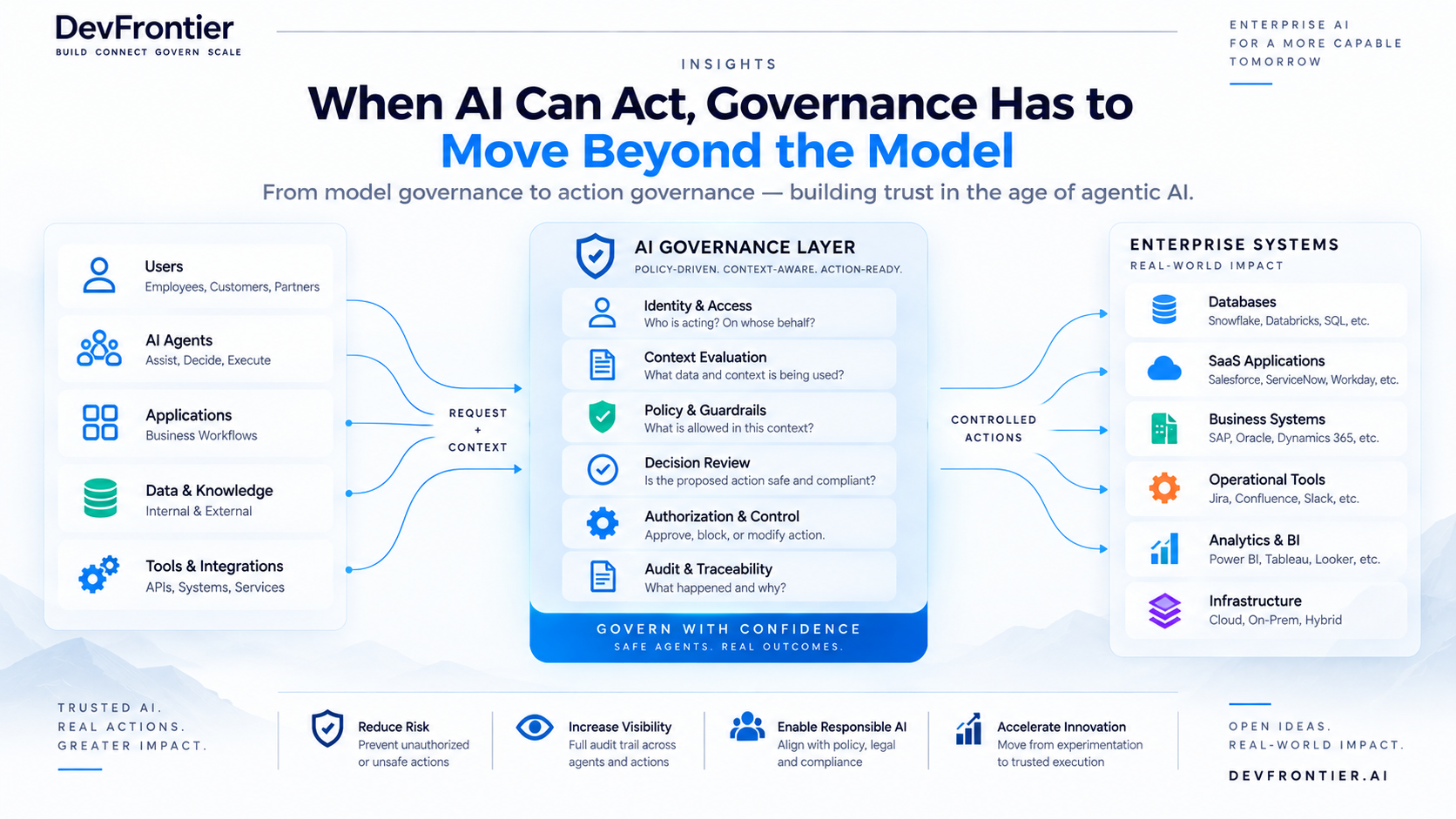
Agents should not communicate with enterprise systems directly. Instead, all tool calls should be routed through a centralized AI Integration Gateway.
<Figure src="/darklogo.png" alt="AI Gateway Architecture" caption="A conceptual model of an AI Integration Gateway intercepting and validating agent tool calls." />This gateway acts as a deterministic firewall. When an LLM decides to call DELETE /api/v1/customer/123, the request hits the gateway first. The gateway can perform strict validation:
- Does this agent have permission to call
DELETEon this endpoint? - Are the parameters valid and within acceptable boundaries?
- Does this action trigger a rate limit or anomaly detection threshold?
3. Deterministic Circuit Breakers (Human-in-the-Loop)
Some actions are simply too sensitive to be fully automated. Operational Governance requires the implementation of deterministic circuit breakers.
When an agent attempts a high-risk action (e.g., initiating a wire transfer, deleting a production cluster, or mass-emailing clients), the Integration Gateway intercepts the request and places it in a holding queue. A human operator is pinged via Slack or an internal dashboard to review the agent's proposed action and its chain of reasoning.
Only upon explicit human cryptographic approval does the gateway execute the action. This ensures that the speed of AI is balanced with the accountability of human oversight.
4. Blast Radius Limitation
In traditional software engineering, a bug might cause a microservice to crash. In Agentic AI, a reasoning loop bug could cause an agent to endlessly provision expensive cloud resources.
Governance must define the absolute maximum blast radius of an agent.
- Time Boxing: Agents should have a strict Time-to-Live (TTL) for complex reasoning tasks.
- Budget Caps: Agents should be restricted by API cost budgets, automatically halting if they consume more than $50 of inference compute in a single session.
- State Reversal: Where possible, agents should execute changes in sandbox environments or utilize database transactions that can be easily rolled back if the final state validation fails.
The Future of Enterprise AI is Governed AI
The race to deploy autonomous agents is accelerating, but the winners will not be the enterprises that deploy the fastest. The winners will be those who deploy the most securely.
At DevFrontier, we believe that the missing piece of the Agentic AI revolution is the governance layer. You cannot scale what you cannot control. By moving governance beyond the model and embedding it deeply into the infrastructure and integration layers, enterprises can finally unlock the true ROI of autonomous AI systems without compromising their security posture.
The models will continue to get smarter, but your infrastructure must remain the ultimate source of truth, security, and control.